What is an AI agent, and does your business need one?
'AI agent' is used loosely, which makes it hard to judge whether one would help your business. The useful definition is simple: an AI agent is software that can be given a goal, decide the steps, use your tools to carry them out, and hand over to a person when it should.
 By Saleem Ahmed · · 9 min read
Last updated:
What separates an agent from a clever chat window
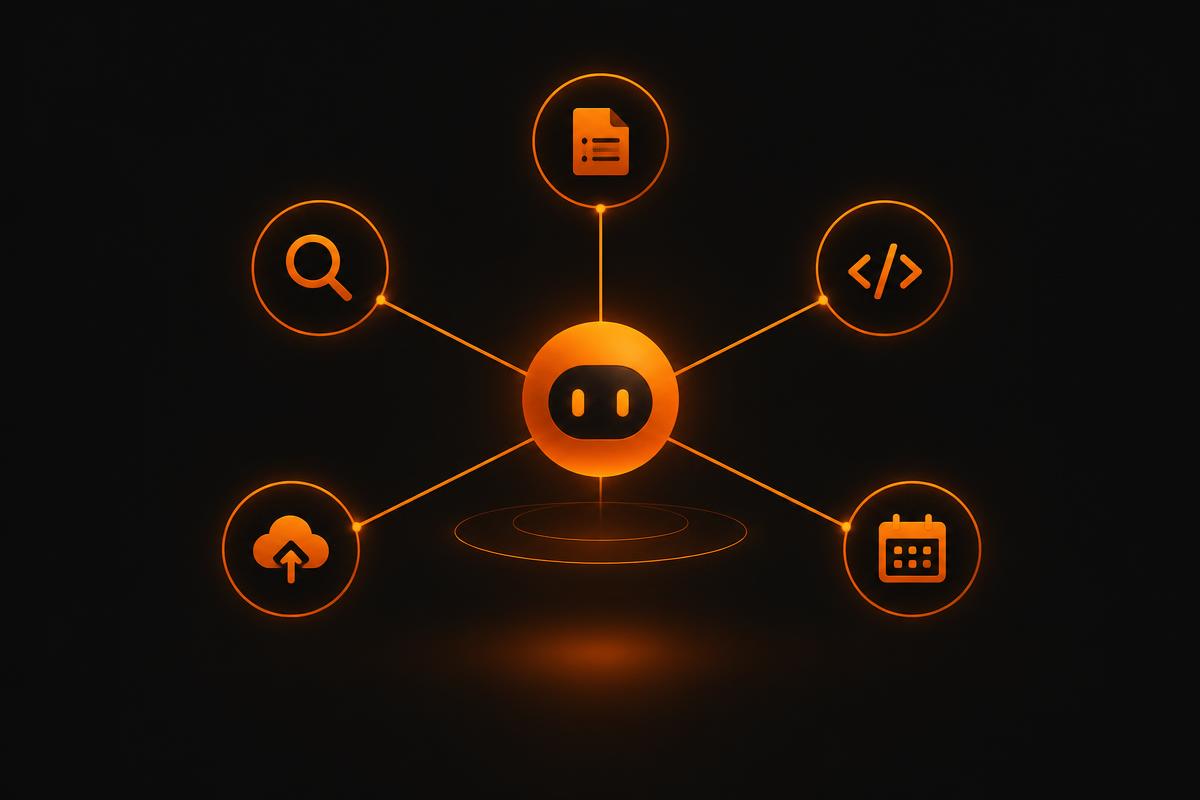
A chat window answers. An agent acts. If it can look up an order, update a record, book a slot or send a follow-up without a person driving each step, it is behaving like an agent.
- It has a goal, not just a prompt.
- It has permission to use specific tools, such as your CRM or inbox.
- It follows your rules about what it must never do alone.
- It escalates to a human with the context attached.
The work agents are genuinely good at
Agents earn their place on high-volume, low-judgement work that follows a pattern: answering the same twenty customer questions, qualifying enquiries, pulling details out of documents, chasing missing information and keeping two systems in step.
They are a poor fit for decisions that carry legal, clinical or financial weight, or anything where being wrong once is expensive.
A simple test for whether you need one
Pick the task your team complains about most. If it happens many times a week, follows a repeatable pattern, and the information needed already lives in a system you own, it is a candidate. If any of those three is missing, fix the process first.
How to start without a big commitment
Start with one task, in a place where a mistake is visible and cheap — draft replies a person approves before sending, for example. Measure the time saved for a few weeks, then widen the remit once you trust it.
How an AI agent actually works, step by step
Underneath the marketing, most business AI agents follow the same loop. A trigger arrives: a customer message, a new form submission, an email landing in a shared inbox or a scheduled check. The agent reads the context it has been given, which usually includes your instructions, a set of approved documents and the history of the conversation or record it is working on.
It then decides what to do next. That might be answering a question from your knowledge base, asking a clarifying question, looking up an order in your system, booking a slot in a calendar or drafting a reply for a person to approve. Each of those actions is a 'tool' the agent has been explicitly allowed to use. If a tool has not been connected, the agent cannot use it, which is one of the most important safety controls you have.
Finally, it records what it did. A well-built agent writes a clear log of every decision, the information it relied on and the action it took, so that your team can review its work in the same way they would review a new member of staff.
- Trigger: something happens that the agent is watching for.
- Context: your rules, documents and the record in question.
- Decision: answer, ask, act or hand over to a person.
- Action: only through tools you have approved.
- Record: a readable log your team can audit.
Where agents work well in a UK small business
The best first uses are narrow, repetitive and high volume. Answering common pre-sales questions out of hours, qualifying enquiries before they reach a salesperson, chasing missing paperwork, triaging a support inbox and updating a CRM after calls are all good examples. They share three traits: the rules are reasonably clear, the information needed is available, and a mistake is easy to spot and correct.
Poor first uses tend to be the opposite. Anything involving legal advice, regulated financial decisions, medical judgement or sensitive complaints should keep a person firmly in charge. An agent can still help in those areas by summarising, drafting or routing, but it should not make the final call.
A useful test is to ask whether you would be comfortable giving the same task to a capable temp on their first week, with a written guide and someone to ask. If the answer is yes, an agent is probably a good fit.
Costs, data and what to check before you start
For a UK SME, a focused first agent typically costs somewhere in the low thousands to build when it uses your existing systems, plus a monthly running cost made up of AI usage, hosting and support. Usage costs scale with volume, so a business handling a few hundred conversations a month will usually pay modest amounts, while high-volume support desks need proper forecasting.
Data protection matters from day one. Under UK GDPR you need to know what personal data the agent sees, where it is processed, how long it is kept and how a customer can ask for it to be deleted. Choose providers that offer clear data processing terms and avoid sending more personal information to the model than the task requires.
- Write down the one job you want the agent to do first.
- List the systems it needs to read from and write to.
- Decide exactly when it must hand over to a person.
- Agree how you will measure success after 30 days.
- Check your privacy notice covers the new processing.
About the author
Saleem Ahmed, Director of CodeCue Technologies
With an MSc in Project Management and degrees in Computer Science, Saleem has led a 40+ person in-house team delivering software, mobile and AI projects for international clients since 2018.
View profile